Words as Gatekeepers: Language, Power, and Disability
Language is never just about words: it shapes who is believed, included, and supported. This post explores how the language we use around disability, particularly non-visible disabilities, can either reinforce ableism or create space for dignity, agency, and belonging.
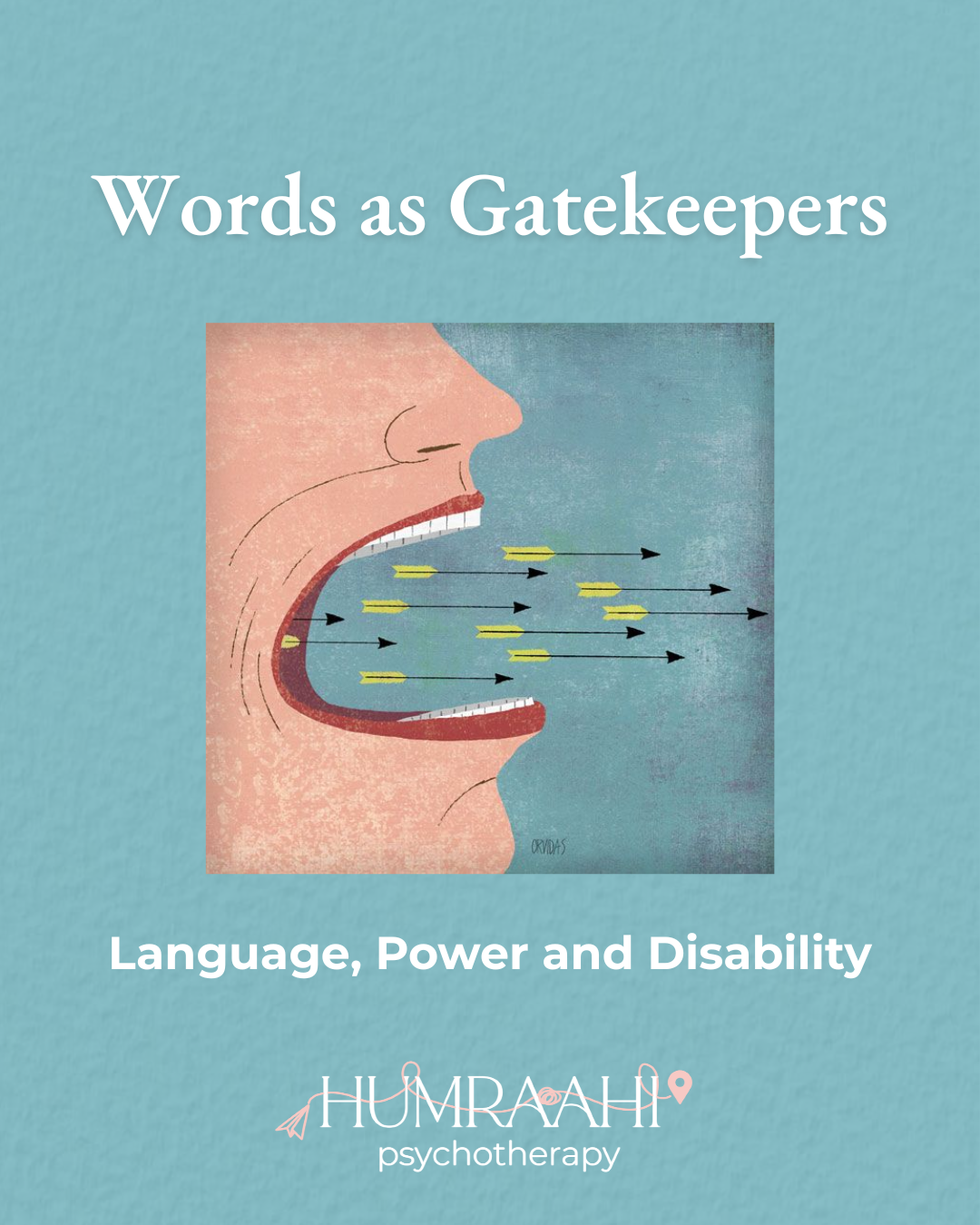
Language is not neutral — it is political.
In disability discourse, words do more than describe; they reflect histories, power, and values, and often govern belonging. The language we choose can affirm dignity, complexity, and agency, or they can quietly uphold systems that exclude and erase.
For people with non-visible disabilities (NVDs) such as chronic pain, neurodivergence, autoimmune disorders, and mental health conditions, language often determines whether they are believed, supported, or dismissed. It shapes not just how others see them, but whether they are allowed to move through systems of care, education, work, and community life without having to barter for legitimacy.
A casual “But you don’t look sick” may sound harmless to the speaker, but for the listener, it can land as a denial of their reality. If it happens enough times, it leads to subtle erosion of self-trust.
The politics of language remind us that words are not just descriptors - they are gatekeepers to resources, belonging, and legitimacy.
Medical systems may demand proof before offering care.
Workplaces may subtly (or overtly) question accommodations.
Friends may unintentionally shame someone for “not trying hard enough.”
In these moments, the disability is not just limited to the body, but it is the world that refuses to make room for it.
The politics of language in disability studies is about power:
Who gets to name disability? Who decides what is “normal”?
The medical model often positions disability as a defect to be cured, while the social model reframes it as a mismatch between bodies and inaccessible environments. Language reflects these positions:
“Wheelchair user” (active agent) vs “confined to a wheelchair” (passive victim)
“Person with a disability” vs “Disabled person” — both valid, but the choice must rest with the individual.
Some prefer person-first language to emphasise personhood; others choose identity-first language to claim disability as an integral part of who they are. It is about agency, not correctness.
What makes a disability “invisible,” and to whom?
For the hearing community, deafness can be invisible until communication breaks down. For mental health disabilities, the absence of visible assistive devices fuels disbelief. The language we have (or lack) shapes what is acknowledged as disability in the first place.
Living with an NVD often means:
Navigating uncertainty and symptom fluctuations
Managing the pressure to mask pain or difficulty
Carrying the constant burden of convincing others of one’s needs
Facing access challenges that range from bureaucratic hurdles to social invalidation
“Passing” may bring temporary social ease but at the cost of undermining one’s own needs.
As Dr Stephen Shore, an autistic educator, says:
“If you’ve met one person with autism, you’ve met one person with autism.” No disability experience is homogeneous. Assumptions erase individual realities.
Phrases like “Everyone gets tired” or “She’s doing it, why can’t you?” dismiss lived realities and pile on a double burden to constantly “come out” as disabled, or to educate and prove the legitimacy of one’s condition before receiving accommodations
Over time, these patterns:
Fuel internalised ableism and shame
Push people into masking or overcompensating
Delay care and accommodations
Intensify mental health struggles
Holding space for NVD means slowing down before we name, label, or assume. It means practicing curiosity over certainty, asking What would make this space safer for you? rather than Can you prove you need it? It’s about understanding that the invisibility of someone’s condition doesn’t make it less real—only less visible to our limited ways of seeing.
If we listen deeply, with compassion and openness, language can shift from being a tool of exclusion to a bridge for connection. And sometimes, that shift begins with the simplest act: believing someone the first time they tell us what they live with.
Our work as therapists must account for how language, disability, and power work together in structural ways.
Ask individuals what language they prefer — and respect it
Name microaggressions and replace them with validating alternatives
Recognise that visibility is a privilege, not a baseline
Hold space for fluctuation, uncertainty, and disclosure fatigue
Design systems that do not require proof to grant access
When we change language, we don’t just change how we talk — we change what (and who) is possible in the world.