
Why Lived Experience Must Be Centred In Disability-Affirming Therapy?
Lived experience is a form of knowledge that no diagnostic framework can fully capture. Drawing from disability justice perspectives, this piece explores why centring the voices of people with lived experience leads to more ethical, responsive, and collaborative care. Rather than positioning professionals as the sole experts, it invites us to recognise that healing begins by meeting the wisdom people already carry about their own lives, bodies, and survival.
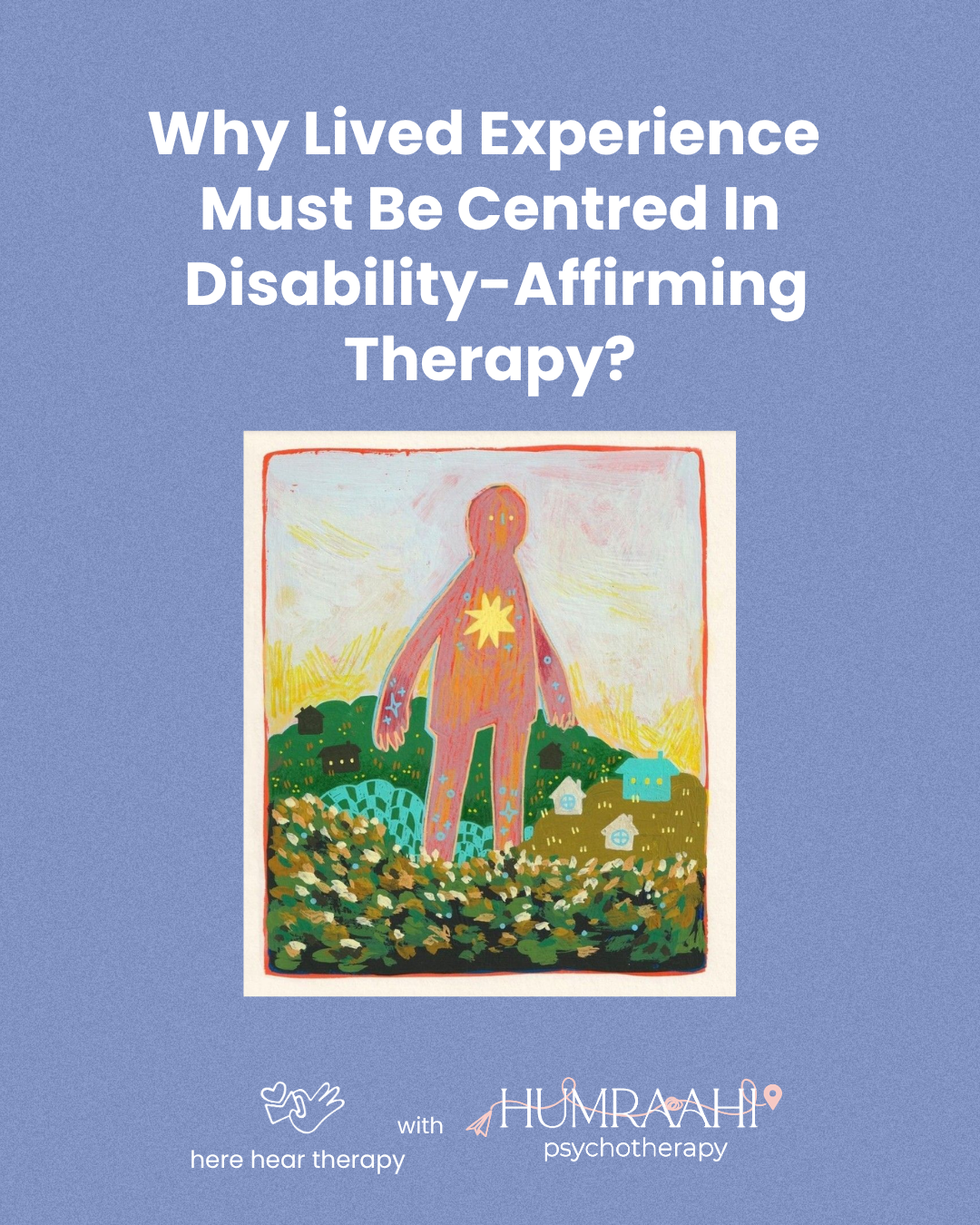
In Disability Visibility: First-Person Stories from the Twenty-first Century, Alice Wong writes, “There is so much that able-bodied people could learn from the wisdom that often comes with disability. But space needs to be made. Hands need to reach out. People need to be lifted up."
Lived experience is not something to be added on after the fact, but something that must be centred as expertise in its own right.
Moving beyond diagnostic frameworks does not mean discarding them; it means recognising where they fall short. This is especially true for non-visible disabilities, where pain, fatigue, and fluctuating capacity are often misunderstood, or minimised.
These experiences do not always fit neatly into categories, timelines, or severity scales. They shift from day to day, moment to moment.
Lived experience carries this knowledge in ways no manual can.
“The diagnosis spoke about me. Experience spoke from me.”
When experiences are inconsistent, fluctuating, or hard to categorise, people often learn to blame themselves rather than question the limits of the framework.
Recognising lived experience as knowledge allows distress to be understood in context, shaped not only by the person, but by the world they are trying to live in.
Frameworks, diagnoses, and evidence-based practices matter, but they do not always capture how distress is navigated in everyday life, how people adapt quietly, or how survival strategies are formed long before therapy begins.
People are already experts in their own bodies, thresholds, and meanings.
Therapy does not create this knowledge; it meets it.
Centring lived experience asks therapists to move away from positioning themselves as sole experts and learn with people, not about them.
It echoes a principle long articulated in disability and survivor movements: Nothing about us, without us.
When care is shaped without the voices of those receiving it, important truths are lost. When those voices are centred, therapy becomes more responsive, ethical, and alive.
Care works best when lived experience is recognised as expertise living within the body as adaptations, skills, survival and resistance.