
Why Does Therapy Have To End?
Ending therapy can bring relief, pride, uncertainty, and grief—all at once. This piece explores why therapy is designed to end, what makes termination such an emotionally significant part of the therapeutic process, and how the goal of therapy is not lifelong dependence but growing confidence in your own ability to navigate life. It reflects on the bittersweet nature of saying goodbye, the value of gradual endings, and how therapy becomes something you carry with you rather than a place you remain in.
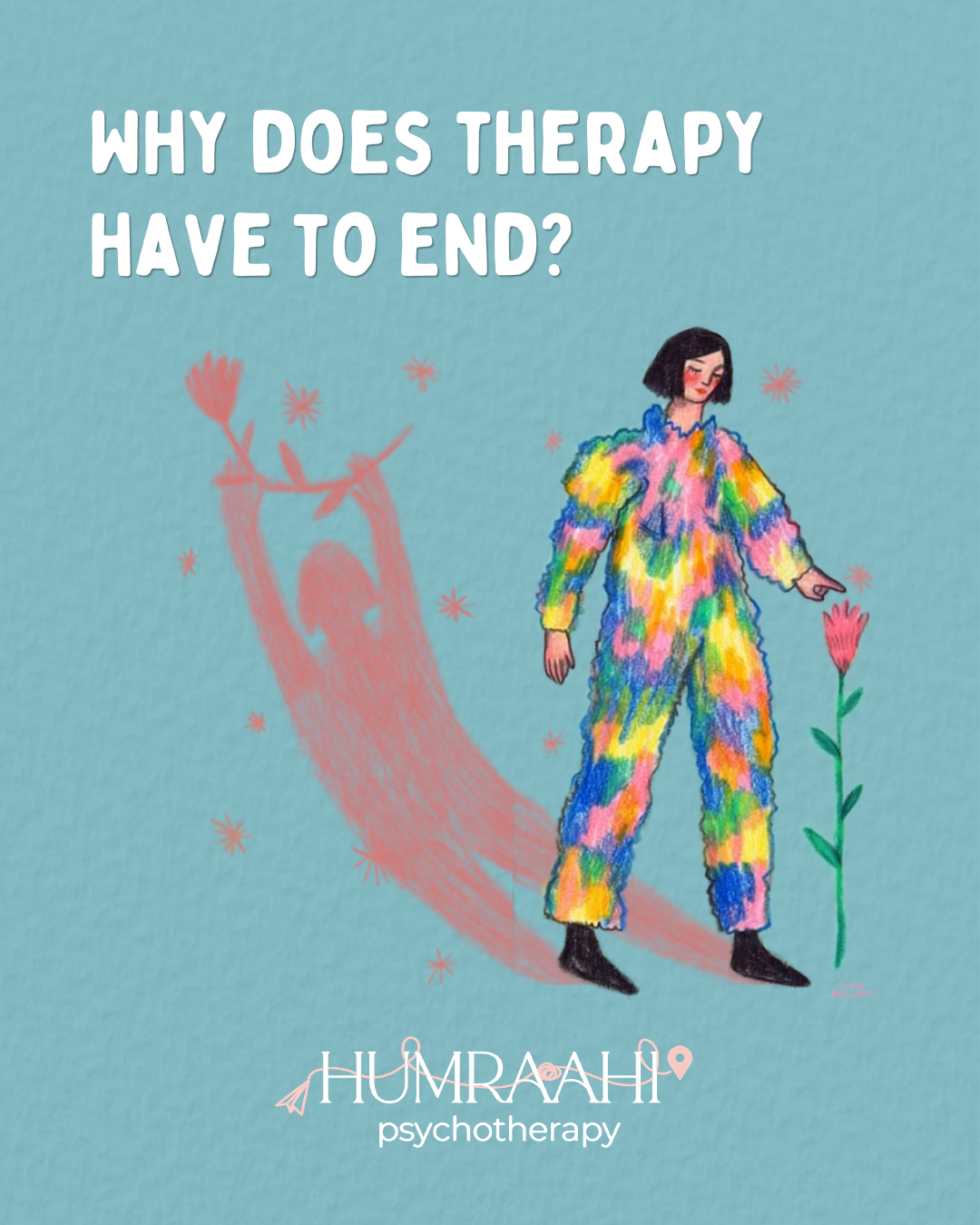
When therapy’s been going well for you, you look forward to coming back to the space each week. It’s been your ‘constant’ in a life of uncertainty.
In the midst of this warm stability, your therapist throws you a curveball and suggests that you might be ready to end therapy.
Panic ensues. “What? Why would they even say that? What if I’m not ready, and I lose all of my progress?”
This isn’t an uncommon fear.
We’ve often felt cushioned and held by the therapist when relationships and situations felt difficult to tackle. Life without therapy can feel ambiguous, almost like you’re losing a guiding voice.
The predictability that you have a space in your therapist’s office at the same time each week itself regulates you into putting effort into your mental health.
It begs the question for many of us- Why can’t this go on, and why does therapy have to end?
The ripping truth of the matter is that yes, therapy is conducted with an intention for it to end.
Your therapist works with you to build skills and perspectives that foster an independence within you. More than just the techniques that are conducted within therapy, it is the kind of presence of the therapist itself that often acts as a healing soundboard, from which you safely venture into your life and work through your emotional struggles.
After all, therapy is not a social relationship- It is a paid, contained, structured and intentional space that enables you to make sense of your world and realise your core needs.
While your therapist would still feel immense care for you, they are also aware that the therapeutic process is not complete if their clients still rely on them for coping with everyday life.
Therapy is made to be a bridge,
not a home.
At some point, you will step off this bridge and start walking on your own. You would likely start to learn healthier and more realistic ways of relating to yourself, other people and the world around you.
When therapy is a promised constant for the rest of your life, you run the risk of outsourcing your emotional regulation and self-help skills to others.
Learning to trust ourselves and take a leap of faith is one of the bravest and most crucial parts of therapeutic work.
Besides, goodbyes don’t have to be sudden if you don’t want them to be.
A feeling of dependence may be an indication that we are yet to internalise the therapist’s presence in our own minds.
‘Maintenance’ sessions at a tapered frequency help a great deal with this.
At the same time, we learn to build external support systems in our family, friends and community members. By building social support, knowing our mental health and understanding our triggers, we get a better sense of when we can lean on ourselves, and when we may actually require to step back into therapy.
Goodbyes are difficult.
Much like graduating, terminating therapy can feel like a bittersweet moment. You're sitting on the cusp of a loss and a milestone.
Soak in the multiple feelings that may arise.