
Learning to Love & Trust Again
Relational trauma is often invisible, shaped not only by what happened but by the love, safety, and care that were missing when they were needed most. This piece explores how our present-day patterns can be understood as survival responses to earlier relationships, inviting us to replace self-judgment with compassion and to recognise that healing begins by experiencing safety, trust, and connection in new ways.
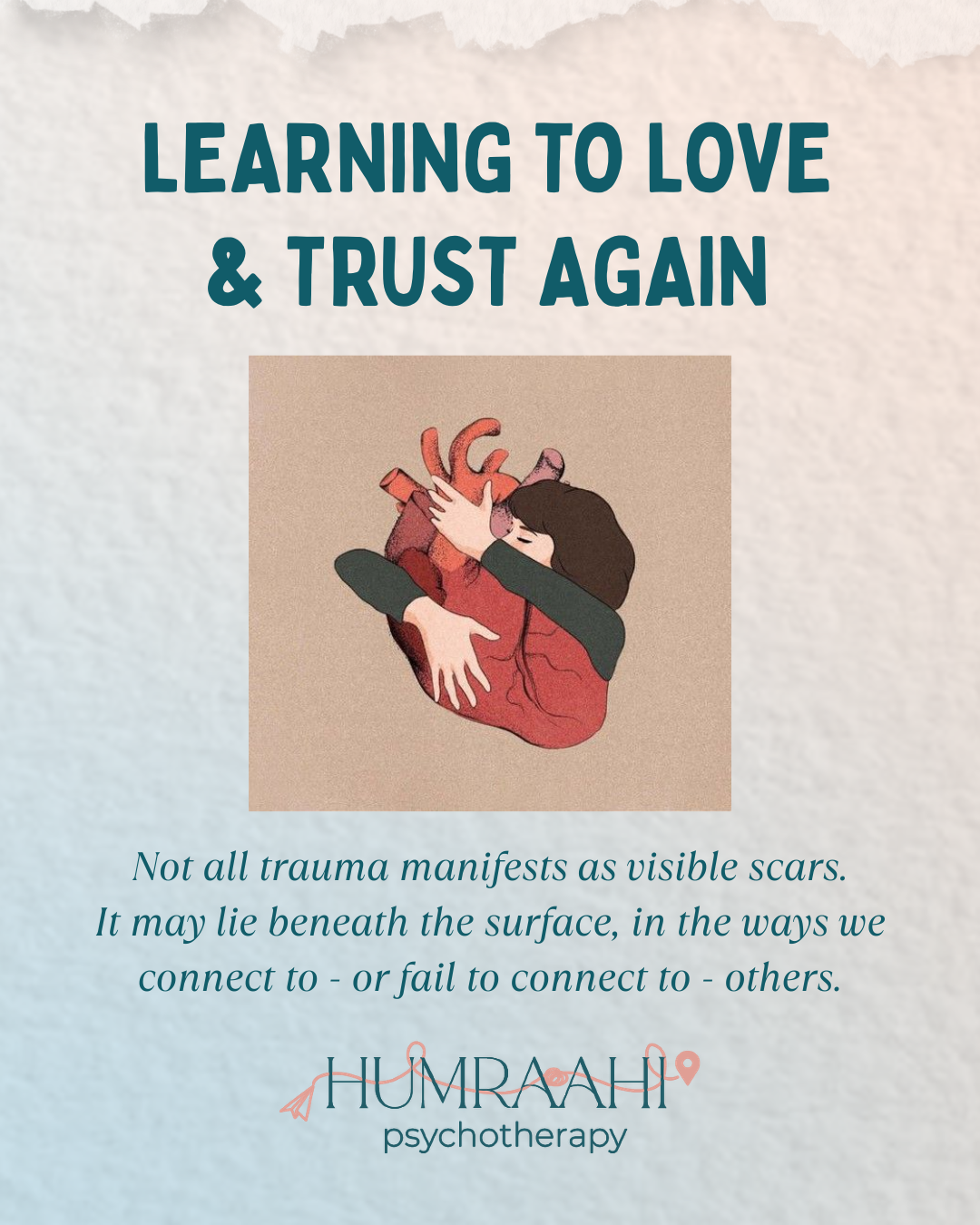
When we talk about trauma, our minds often go to the dramatic — accidents, disasters, violence. But many of us carry a quieter, more invisible kind of pain: relational trauma.
Trauma isn’t just about what happened — it’s also about what should have happened, but didn’t.
The care you longed for but didn’t get.
The protection that never came.
The moments you needed comfort and were met with silence.
Relational trauma isn’t about a single event — it’s about what kept happening: the ongoing absence of safety, trust, or care in the relationships that should have felt safest.
It’s the parent who withdrew affection when you didn’t perform “well enough.”
It’s the friend group that made belonging conditional.
It’s growing up needing to be the caretaker, the peace-maker, or the one who seemed to need nothing at all.
Over time, our nervous system learns the pattern:
“Love is earned.” “It’s safer not to depend on anyone.” “My needs are too much.” “If I’m perfect, maybe I’ll stay safe.”
This is what relational trauma often looks like — years of learning that love came with conditions, care had strings attached, or it was safer to shrink yourself to be accepted.
The stagnant dysfunction of today might have been the surviving function of yesterday.
These aren’t flaws. They are our mind and body’s ways of keeping us safe when love, care, or consistency feels out of reach.
What would it look like to re-think the symptoms we carry, as responses to something old, familiar and unsafe?
When we say ‘survival, not symptoms,’ we’re choosing kindness over judgment. We are recognising the ways you did your best to stay afloat when connection felt uncertain or unsafe.
Healing relational trauma isn’t about fixing what’s ‘wrong’ with you. It’s about showing your nervous system that safety, love, and trust are possible again, first within yourself, and then with the people around you.
As Brené Brown reminds us, ‘Owning our story can be hard but not nearly as difficult as spending our lives running from it.’"