
I Feel Like I’m Back to Step One
Progress in therapy is rarely linear, and revisiting old patterns doesn't mean you've lost the growth you've worked so hard to build. This post explores why setbacks, triggers, and moments of feeling "back at square one" are a natural part of healing, and how meeting them with compassion, rather than self-criticism, can deepen the therapeutic process.
Picture this: You’ve been showing up to therapy, holding a mirror to the consequences of your thoughts and actions, and even putting in the work to challenge your long-standing patterns.
This sounds wonderful, and you should appreciate yourself for the steps that you’ve been taking.
This is what you expected from therapy - and yet, despite putting in the work, you find yourself having moments where you feel just as impacted, distressed or stuck from something that you thought you had out-grown or moved on from.
This could look like considering getting back with your former partner, re-experiencing your feelings of low self-worth, feeling a wave of grief for a family member you lost, or even having rocky trysts with procrastination.
What does it mean when you repeat old patterns, and why is it happening? Things should be going “right”, right?
The therapy space can feel immensely rewarding when you’re able to witness its impact on your progress. Yet, it is for this same reason that feeling re-triggered can be deeply disheartening.
It's important to know that confronting barriers in your journey and feeling vulnerable afterwards is normal, and it is certainly not an indication that your inner work has not paid off.
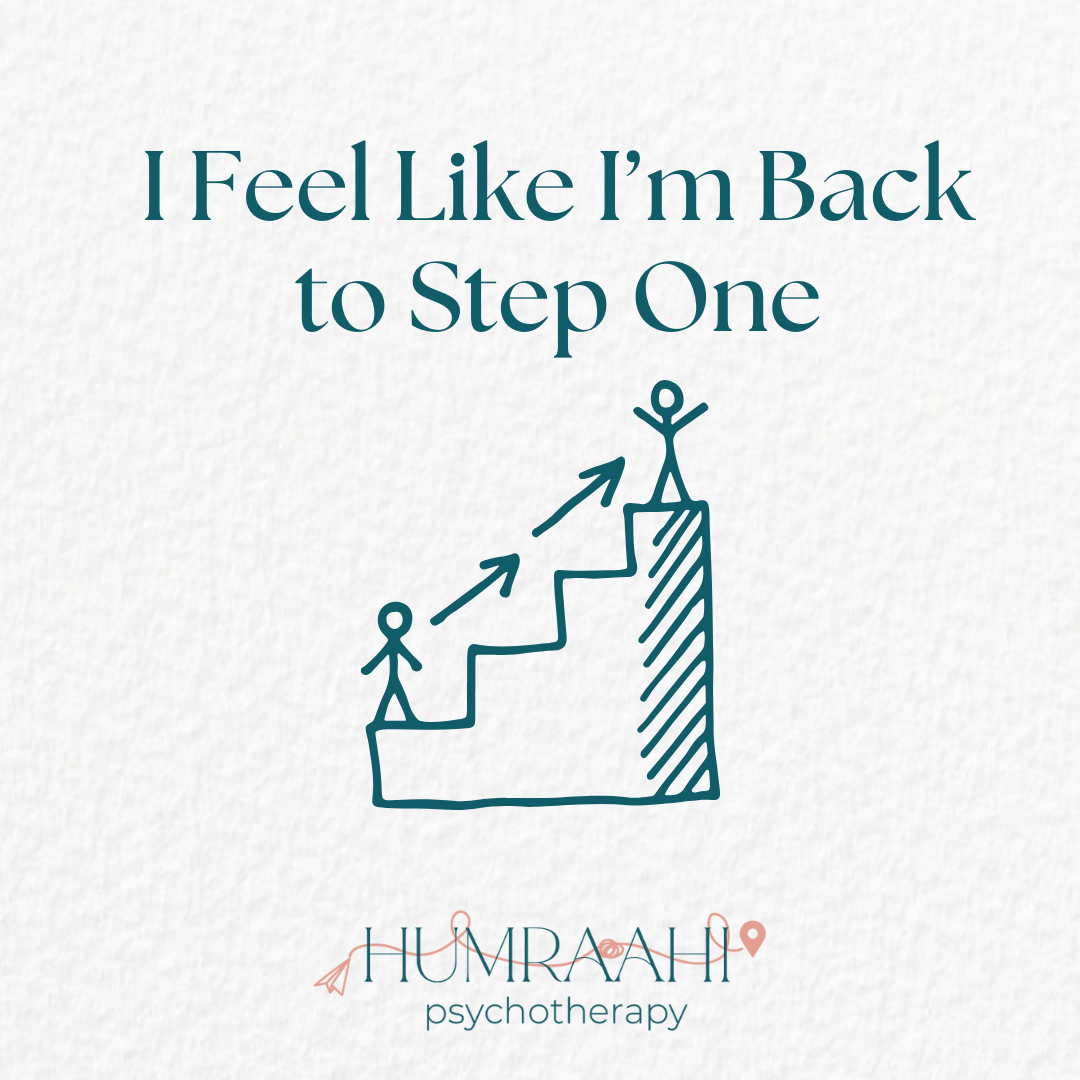
Your growth, whether inside or outside of therapy, will most probably not look like a clean, straight and upwards-facing slope.
In therapy, when we start to become aware of our repeated cycles and understand how to confront our deeper fears, it may feel liberating to have a clear map of what’s ahead. However, living in this complex and intricate world doesn’t always offer us this clarity.
For instance, the people whom we love and who may even depend on us may bring us back into some self-repeating patterns, making us feel confused, helpless or stuck.
Other times, we have done the inner-work, but reminders of the past can tempt us to pursue familiar patterns to feel the comfort of familiarity, even when it brought struggle with it.
These are some of the many situations where we become more friendly with the brake than the accelerator.
However, much like a car that’s stopped at a signal, our bodies and minds are slowing down to process the difficulty of a certain moment. Cars look parked in front of red lights, and yet we’re all aware that their journey has not ended. Maybe it’s time to acknowledge what our red lights might be, so that we express a greater kindness to ourselves.
Fearing change and feeling comfortable even in an unhelpful routine is an ironic part of being human, which is held and challenged safely when you’re in therapy.
Being human also means that you are intricately weaved into many systems that make you who you are – religion, customs, family, work culture, academic institutions, early experiences, socio-economic status, personality and much more.
All of these structures may inform you about who you are, how the world is going to be, and what your responsibilities towards the world are.
In beginning to unlearn any of these scripts in therapy which may be unhelpful or inaccurate, you may find yourself shifting between the desire to move ahead and the desire to belong again to these familiar structures. Even if you are resolute in moving away from a certain way of living, circumstances may take place beyond your control, and this isn’t your fault.
The idea of a smooth journey of growth within therapy is often informed by the ideologies of the hustle cultures that are brought in by the client or the therapist.
The idea of quick and linear growth dismisses your needs to be seen and understood for the barriers and contexts you come from.
In light of the worry that you may feel when you think that you are back at step-one, it can be important to sit with a couple of reflections : Despite feeling ‘retriggered’, you were likely able to step back from your emotion and recognise that your reaction took you away from your authentic self.
Therapy is as difficult as it is gratifying.
Through this difficult journey, do keep in mind that delving into previous patterns does not reverse or undo the progress you have made thus far. It simply serves as a reminder of why we began the process of therapy and self-reflection in the first place.