Beyond What Meets The Eye: Recognising the unseen struggles, limits, and daily realities of non-visible disabilities
What happens when our understanding of disability depends only on what we can see? This piece explores the lived realities of non-visible disabilities, reflecting on the quiet labour of navigating pain, fatigue, fluctuating capacity, and the burden of having to continually prove experiences that remain unseen. It invites us to move beyond visibility as the measure of legitimacy and towards a more expansive understanding of disability, one grounded in trust, dignity, and care.
In When Breath Becomes Air, Paul Kalanithi writes,
“Science may provide the most useful way to organise empirical, reproducible data, but its power to do so is predicated on its inability to grasp the most central aspects of human life: hope, fear, love, hate, beauty, envy, honour, weakness, striving, suffering, virtue.”
These aspects of human life that often go unseen are daily negotiations that people with non-visible disabilities live with, even when the world cannot measure or easily understand them.
Fatigue, pain, cognitive overwhelm, and sensory struggles exist quietly, but they shape every day. These are experiences that numbers and tests cannot capture; and yet they are real, persistent, and deeply felt.
Erasure and the Burden of Proof
Erasure often arrives softly, almost invisibly.
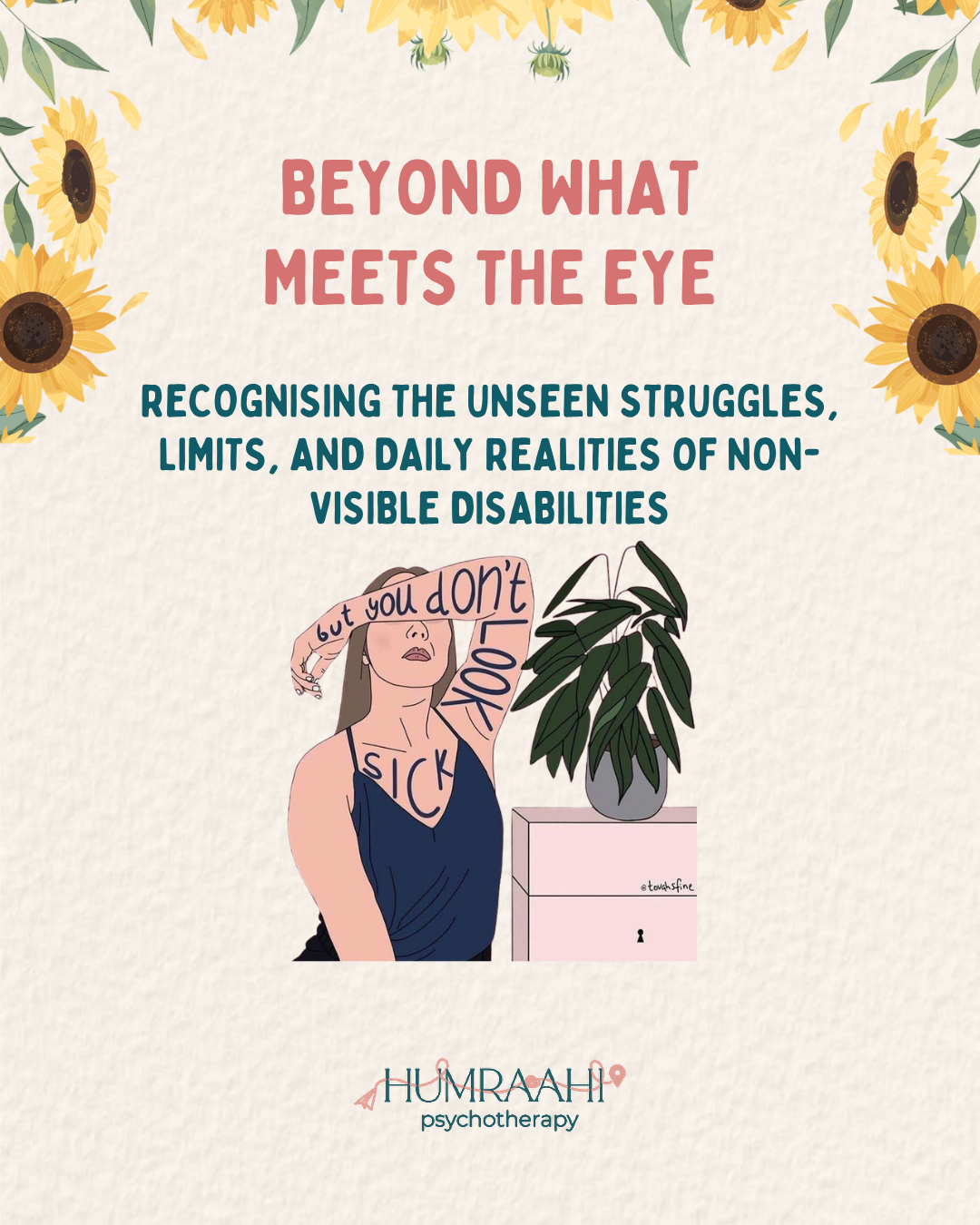
A questioning look. A “but you look fine.” An assumption that tiredness, pain, or cognitive struggle is exaggeration.
It can be a well-meaning comment, a casual doubt, or a repeated pattern of small dismissals that gradually accumulate. Each moment quietly asks you to shrink yourself, to make your experience smaller, slower, or simpler so the world can digest it.
Over time, this can erode self-trust, leaving you feeling unseen, unheard, and profoundly isolated, carrying the weight of experiences that no one else seems to acknowledge.
Non-visible disabilities are frequently tagged as “imaginary” not because they lack presence, but because our societal definitions of illness still rely heavily on visible markers. When there is no cast, no assistive device, no lab value to point to, doubt fills the gap.
This disbelief shifts the burden of proof onto the person living with the disability, asking them to present their suffering in ways that others find legible. In this dynamic, invisibility becomes a structural disadvantage rather than a neutral characteristic.
“Bahaane” and the Moral Weight Placed on Bodies
In many cultural contexts, particularly in South Asia, the word “bahaane” (excuses) becomes a shorthand for disbelief, which in turn implies that a person’s limitations are moral failings, not embodied constraints.
Every flare-up, every request for rest, every accommodation, becomes a negotiation – an unchosen test of your reality.
Capacity: The Unseen Ups and Downs
A central misunderstanding is the conflation of capability with capacity. You may have the skills or knowledge to do something, but not the energy or resources to do it today. Systems and relationships often measure you against what you can do in ideal circumstances, rather than what you can sustain.
Fluctuation is part of living with a non-visible disability, and your worth does not decrease when your capacity does.
Passing: The Survival Skill No One Talks About
Many people with non-visible disabilities learn to “pass” as non-disabled — not to hide themselves, but to move through a world that doubts anything it cannot see.
Passing becomes a practical way to avoid questions, judgment, or the emotional labour of explaining your body to others. But the politics of disclosure sit quietly underneath this choice: showing your needs can invite scrutiny, while keeping them to yourself can make your experiences disappear in the eyes of others. It’s a form of protection, but it carries a quiet weight: the tiredness of managing how you appear, and the loneliness of navigating what others can’t or won’t acknowledge.