
Be A Man!! - What Does Patriarchy Ask Men to Become in the Age of Andrew Tate, the Performative Male, and the Tradwife?
What does patriarchy ask men to become? Be strong. Be successful. Be desirable. Be in control. Be a man. But what if freedom begins when the performance ends? Perhaps dismantling patriarchy isn’t about giving men a better script to perform. Perhaps it is about loosening the demand to perform at all, and making space for men to be uncertain, tender, dependent, afraid, accountable, and simply human.
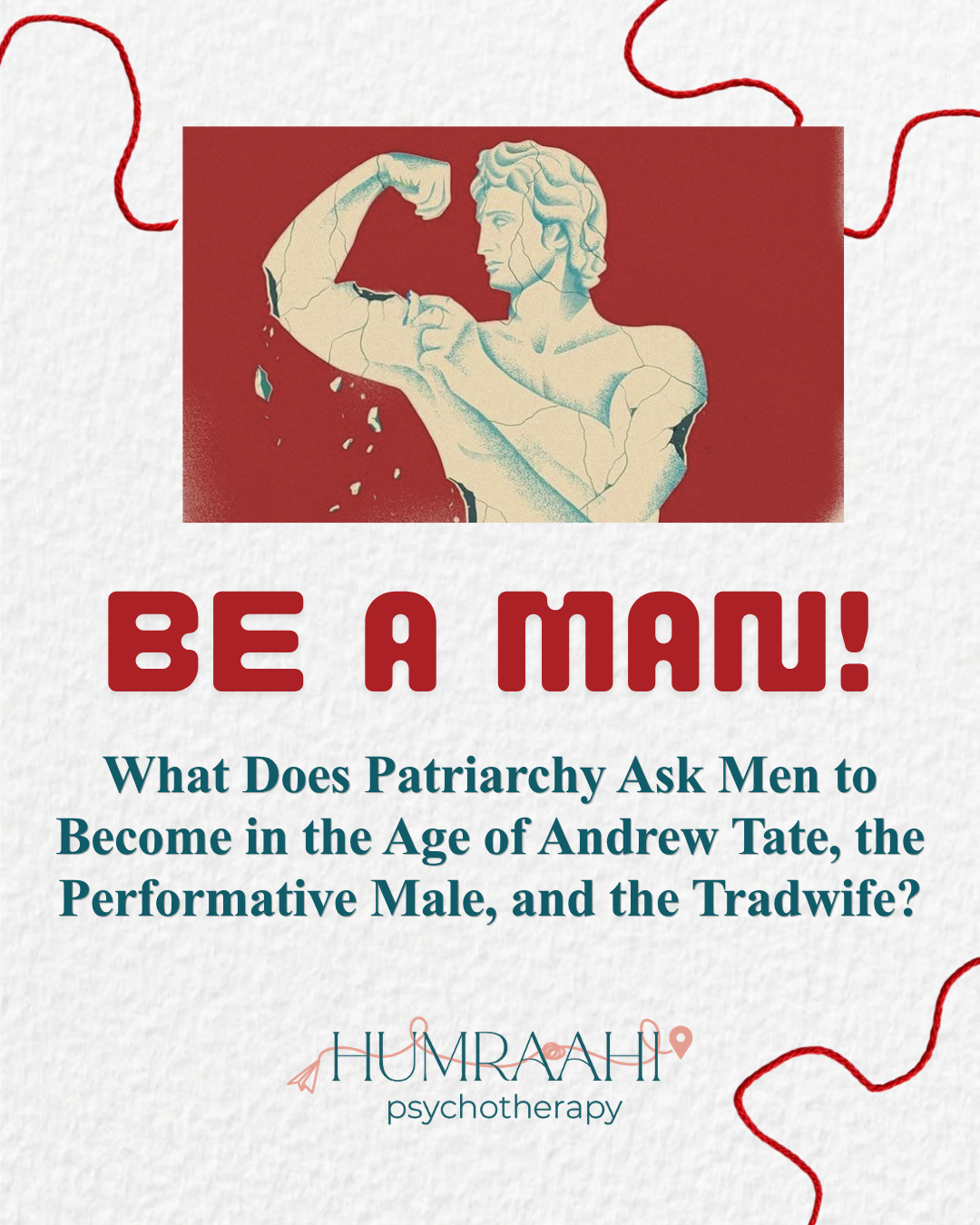
Whether it is a little boy, fallen on the ground, looking towards his father before deciding whether he is allowed to cry, or a husband feeling embarrassed when his wife gets promoted before him -
men may be given power within patriarchy, while simultaneously being denied certain ways of being and becoming.
So what happens to everything that cannot be expressed directly? Where does the fear go when crying is weakness, the hurt when vulnerability is emasculating, the insecurity when failure threatens one's sense of being a man?
Maybe the cry to “be a man!” is really a demand to perform manhood convincingly.
Judith Butler's theory of gender performativity helps understand gender as not simply something we are; but continually produced through repeated socially-enforced acts - not a noun, but a verb. The way we dress, speak, occupy space, express emotion, relate to power, people and the world around us!
And contemporary masculinity offers us many scripts.
Andrew Tate’s influence offers one highly visible script of masculinity: wealth, physical dominance and control. The Guardian, in an article from 2 years ago, called him a symptom, not the problem. Calling him the problem can make it easier to overlook what makes his particular performance of masculinity aspirational to some young men.
Or the men at the centre of Arjun Reddy, Kabir Singh and Animal: dominant, possessive, volatile. They create a familiar fantasy of manhood, and turn masculinity into a highly consumable performance that can be watched, imitated, measured and monetised. The script? I am a man because I provide, protect, and dominate. Then there is also the “woke guy with a tote bag” - the man who signals his difference through feminism, therapy language, emotional openness, progressive politics and the right vocabulary. A man carrying a tote bag and talking about feminism is not necessarily performing progressive masculinity insincerely. But even “progressive” masculinity can become a social identity that is performed, recognised and rewarded.
Social media has made these performances increasingly visible.
The tradwife phenomenon can be considered a parallel of highly curated performances of traditional femininity: domesticity, motherhood, submission and dependence on a male provider. It is a highly sellable aesthetic - a life of sourdough, gardens and beautiful homes, making a particular gender arrangement appear desirable. The tradwife aesthetic offers one script of femininity; the manosphere offers one script of masculinity; the progressive internet offers another. Each tells us, in different ways, what a recognisable man or woman should look like.
In this, we have not escaped old gender roles. We have simply acquired new costumes.
Tate and the tradwife are not identical phenomena, nor should they be collapsed into one. But both reveal something important about contemporary patriarchy: gender roles increasingly circulate as scripts. And scripts require an audience. A public, algorithmically amplified performance.
We are living through an era of hyper-patriarchy: not simply the persistence of traditional gender roles, but their intensified performance through algorithms and influencer culture, in the context of increased economic anxiety, terrifying rape culture and increasingly commodified identities. Masculinity is no longer only something to inhabit; it is something to consume, display, and prove. My thoughts here come back to this: The deeper possibility of dismantling patriarchy may lie not in finding the right way for men to perform masculinity, but in loosening the demand to perform it at all. And perhaps this is where the conversation becomes personal. I feel afraid. I feel furious. Every time another rape is reported, especially here in Delhi, it is difficult not to feel horrified at what it means to move through the world as a woman. The fear is not only of the violence itself, but of the possibility that it could happen anywhere, to anyone, at any time. And alongside that fear is rage that asks how many more times women must learn to be careful before men are asked to learn to stop causing harm. Here, the desire to be a “good man” cannot simply be about not being one of those men. It has to mean confronting the culture that makes violence possible: challenging friends, examining entitlement, respecting boundaries, interrupting misogyny, and being willing to sit with discomfort rather than seeking reassurance. The question cannot simply be “Am I a good man?” It has to be “What do I do with the power I have?” Importantly, the social power to make someone feel safe or unsafe, to respect or disregard a boundary, to challenge or enable the behaviour of other men.