
All That We Carry: Holding Space in a World That Feels Unsteady
Every conversation in the therapy room is shaped by the world outside it. In this piece, we reflect on what it means to practise therapy in the midst of political upheaval, collective grief, and systemic injustice—and why care, witnessing, and connection remain deeply meaningful acts even when they cannot undo the systems that create suffering.
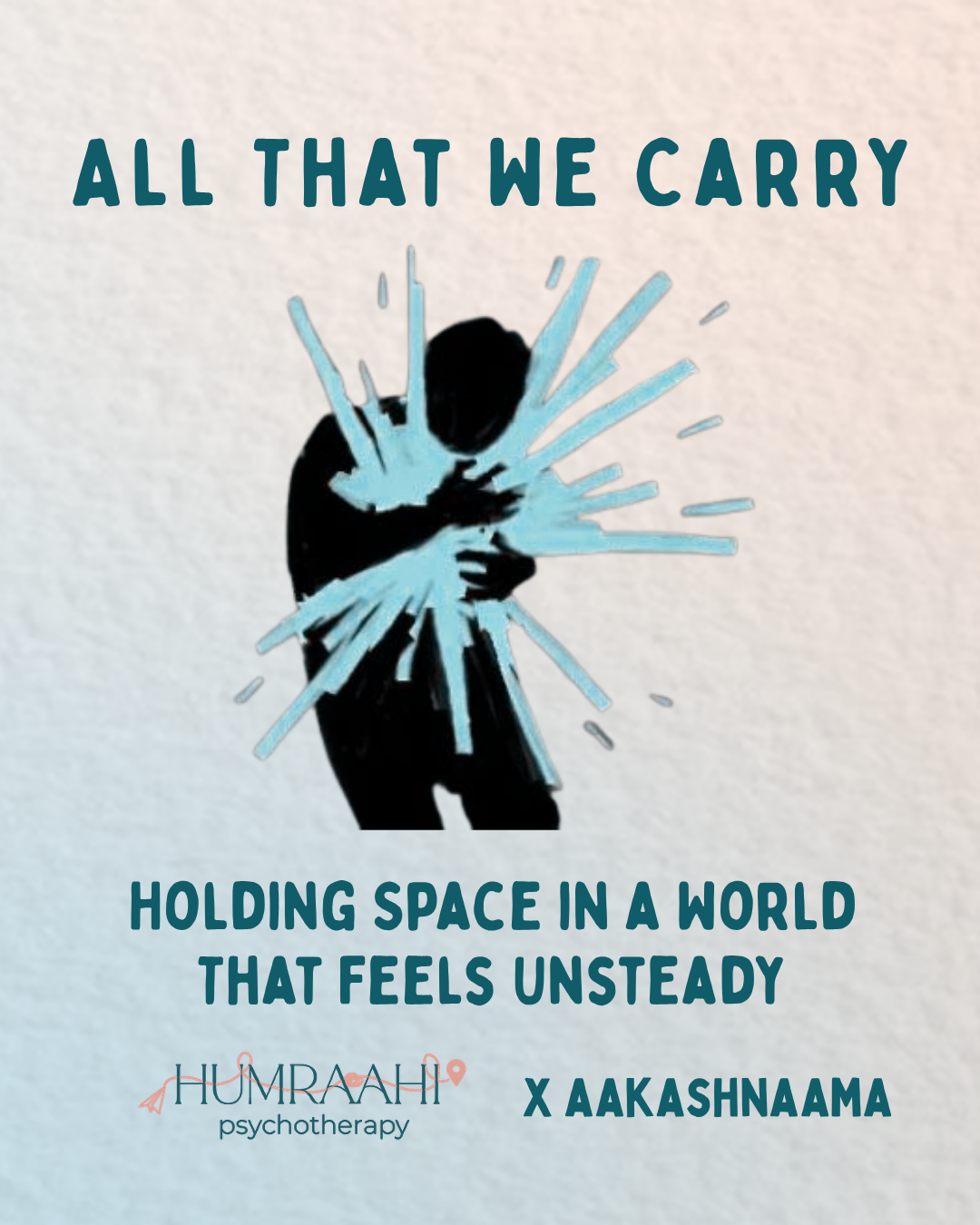
What happens in the therapy room is shaped by the same world we step out into - one dense with political upheaval, the grief of a planet in crisis, and the unshakable presence of collective grief and instability.
Clients arrive carrying stories that cannot be untangled from these realities. And so do we.
As therapists and witnesses, we are not immune to the exhaustion of witnessing an unending cycle of crisis. We find ourselves asking:
How do we continue to show up when the ground beneath all of us keeps shifting?
What values do we hold onto when certainty dissolves?
Where does our own grief live, and how does it speak through our work?
The myth of the therapist as a neutral witness collapses here; we are affected, enmeshed with, and sometimes undone by the very histories our clients bring forth.
Judith Butler (in Precarious Life) argues that recognising our shared precarity is essential for fostering empathy and collective responsibility. This perspective invites us to acknowledge that the suffering we witness is not isolated but part of a broader, shared human experience.
“Being a patient, rather than a participant in one’s healing process, separates suffering people from their community and alienates them from an inner sense of self.” - Bessel van der Kolk
Bessel van der Kolk’s work highlights that trauma is both personal and communal, demanding spaces where healing can unfold collectively. In this light, our work is not only about tending individual wounds but about challenging and reshaping the systems that give rise to them.
In the therapy room, we become bearers of accountability, walking beside as cycles of aggression, violence and passive acceptance are interrupted. We exercise our own power through listening, witnessing, and holding safe spaces. We model the connections, integrity, and accountability that broader structures often fail to uphold.
By doing so, we contribute to a collective effort to heal and transform the systems that perpetuate suffering.